
A basement gym can turn the time you used to spend driving to the gym into an actual workout. When you’re fitting training around work, school pickups, and bedtime, that matters.
The ceiling is often the problem.
A rack might fit between the floor and the joists but leave no room for pull-ups. Rubber flooring can push an already-tight installation over the limit. Ductwork can interfere with loaded plates even when the uprights fit.
The best short squat rack for a low ceiling needs to fit both your room and your movements. This guide compares six Amazon-listed options, including low power cages and folding wall-mounted racks.
For especially low ceilings, start with the 71-inch Titan T-2 or 72-inch CAP full cage. If you have more clearance, the Fitness Reality 810XLT and Titan T-3 offer additional options. For a basement that needs open floor space between workouts, consider a short Titan folding rack.
Quick Picks: Low-Ceiling Squat Racks at a Glance
These measurements apply to the configurations specified below. Choose carefully: Amazon may group short and tall versions, accessories, and bundles on the same listing.
| Rack | Overall height | Published footprint or projection | Listed capacity* | Best fit |
|---|---|---|---|---|
| Titan T-2 Short Power Rack | 71 inches | 57 × 50 inches | 850 lb rackable | Very low ceilings |
| CAP Barbell Full Cage, 6-foot | 72 inches | 43.62 inches wide × 47.5 inches deep | 500 lb static catch capacity | Basic squat-and-bench setup |
| Body-Solid Powerline PPR1000 | 83 inches | 50.9 inches wide × 53.5 inches deep | 700 lb | Full cage with included safeties and optional expansion |
| Titan T-3 Short, 24-inch depth | 82 inches | 54 × 32.75 inches | 1,100 lb rackable | Shallow full cage |
| Titan X-3 Folding, short/shallow | 80.25 inches | 48 inches wide; 23.5 inches from wall | 1,100 lb | Folding rack with 3×3 uprights |
Measure Your Basement Before Choosing a Rack
Start at the finished lifting surface
Measure from the top of your planned flooring to the lowest obstruction above the rack and lifting area.
Check joists, ducts, pipes, lights, and soffits. Measure over both ends of the barbell, too.
For example, an 84-inch ceiling with three-quarter-inch rubber flooring leaves 83.25 inches. That gives an 82-inch rack only 1.25 inches of clearance, before considering assembly access or anything projecting above the frame.
A “power rack under 84 inches” is therefore not automatically suitable for a seven-foot basement.
Include plate diameter
Loaded plates extend above the bar’s centerline.
An approximately 17.7-inch-diameter plate reaches about 8.9 inches above the bar. If the bar’s center reaches 68 inches during a movement, the plate reaches approximately 76.9 inches.
Measure your actual equipment and normal lifting positions. Check the path during unracking, stepping back, and reracking, not just where the bar rests.
Tape out the whole training area
Mark the rack footprint with painter’s tape, then add the bench, plate storage, and full barbell length.
Leave room to load plates without squeezing against a wall. Check that you can get onto the bench and move around the rack without blocking stairs or utility access.
The Best Short Squat Racks to Look for on Amazon
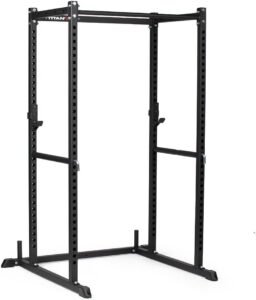
The 71-inch T-2 is the strongest starting point on this list when ceiling height is your main restriction.
Titan lists 2×2-inch, 14-gauge uprights, two-inch hole spacing, and included pin-and-pipe safeties. The current manufacturer specification gives it an 850-pound rackable capacity. Titan T-2 specifications
For a dad building a straightforward basement gym, included safeties make the initial purchase easier to organize. You can focus on a compatible barbell, bench, and plates before considering accessories.
The limitation is the low interior. Tall lifters should check their unracking position and whether they can move under the crossmembers comfortably. Two-inch hole spacing also offers less precision around bench height than one-inch spacing.
Best for: Squats and bench presses in a particularly low room.
Check before ordering: Select the 71-inch version, and confirm that the Amazon model’s specifications match the current rack. Older listings may describe different revisions.
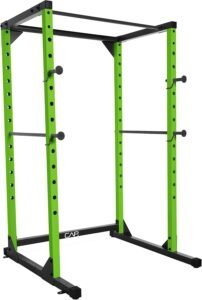
The six-foot CAP full cage is another option when taller racks simply will not fit.
Its Amazon listing specifies a 72-inch height, a 43.62 × 47.5-inch footprint, and included catches and safety bars. The listed 500-pound static catch capacity is separate from the pull-up-bar rating. CAP product specifications
This is worth comparing for a basic routine built around squats and bench presses. Treat it as a complete, specific rack rather than assuming it supports a broad attachment system.
Before purchasing, check whether its safety positions suit your bench and squat depth. A short cage only helps if you can use its safeties correctly.
Best for: A simple setup where 72-inch height is the deciding factor.
Check before ordering: Choose the 6-foot full cage, not a seven-foot version or CAP’s differently configured open racks. The retrieved listing had no featured offer, so seller availability needs confirmation.
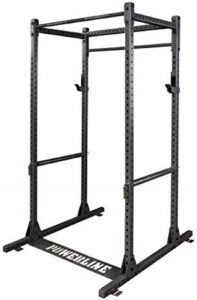
The Body-Solid Powerline PPR1000 comes with J-cups and pin-and-pipe safeties, giving you the basic rack equipment needed for squats and bench presses without purchasing those pieces separately.
Body-Solid specifies a 700-pound capacity, 2×2-inch 14-gauge steel construction, and two-inch adjustment spacing. Its assembled footprint measures 50.9 inches wide by 53.5 inches deep, with an overall height of 83 inches. Compatible options include a lat attachment, rear extension, and T-bar row attachment. Body-Solid specifications
For a busy dad, the appeal is a straightforward starting setup with options to expand later. Measure those additions separately before buying.
Ceiling clearance is the main drawback. Under an 84-inch ceiling, three-quarter-inch flooring leaves just one-quarter inch above the rack. That calculation does not establish adequate assembly or exercise clearance.
Best for: A dedicated basement gym with verified room for an 83-inch cage.
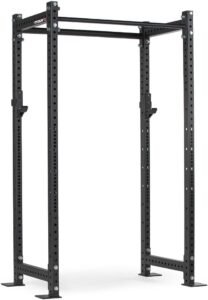
The short T-3 combines an 82-inch height with 2×3-inch, 11-gauge uprights. The 24-inch-depth configuration has a published 54 × 32.75-inch footprint and Westside spacing through the bench zone. Titan T-3 specifications
That shallow layout is useful when the basement’s front-to-back space is tight. Closer adjustment holes around bench height also help with positioning J-hooks.
However, a shallow cage needs to fit your squat movement. Account for forward lean and the bar’s path, rather than assuming less depth is always better.
The frame is also close to a seven-foot ceiling. Flooring and assembly clearance deserve particular attention.
Best for: A permanent cage in a shallow training area.
Check before ordering: Select the 82-inch, 24-inch-depth version, budget for compatible safeties, and follow the anchoring guidance.
The short X-3 folding rack offers 3×3-inch, 11-gauge uprights in a wall-mounted design.
For the shallow configuration, Titan lists an actual height of 80.25 inches, a 48-inch width, and a 23.5-inch projection from the wall. Its listed folded projection is five inches. Titan X-3 folding specifications
This can suit a basement where you want floor space back after training. The bench, barbell, and plates still need separate storage, so plan the entire cleanup routine.
Installation is the main trade-off. Titan lists wall-mounting hardware as excluded. Your wall construction, mounting method, and any supporting structure must suit the manufacturer’s requirements.
Best for: A shared room with a suitable mounting wall.
Check before ordering: Choose the short 80-inch model and confirm approval for the exact spotter-arm setup you intend to use. Accessory fit alone does not establish safe use.
Full Cage, Half Rack, or Squat Stand?
A full cage lets you lift between uprights with safeties spanning the interior. That arrangement is useful for solo training when the cage depth and safety positions match your movements.
A half rack or connected squat stand leaves the front open and generally relies on external spotter arms. Those arms need adequate length and an approved, stable installation.
A folding wall rack saves storage space, but adds mounting requirements and setup steps.
| Design | Practical advantage | Main consideration |
|---|---|---|
| Full cage | Interior catch area for solo lifting | Requires permanent floor space |
| Half rack or squat stand | Open access around the bar | Spotter-arm coverage and stability |
| Folding wall rack | Can clear floor space after training | Structural installation and folding clearance |
A cage does not keep children away from the weights. Any of these designs needs a separate plan for controlling access.
Training Around a Low Ceiling
Overhead pressing alternatives
Seated dumbbell presses reduce the height needed compared with standing presses. Z-presses start from the floor, although they require more mobility and trunk control.
A properly installed landmine attachment provides an angled pressing option. Check the entire bar arc and the floor space it occupies.
Before loading anything, rehearse the movement with an unloaded implement. Include plate or dumbbell height when checking clearance.
For another compact training option, see our Best Adjustable Dumbbells for Compact Home Gyms.
Can you do pull-ups in a seven-foot basement?
Sometimes, but you need room for your head above the bar and your body below it.
Bending your knees addresses floor clearance. It does not create overhead clearance.
A manufacturer-approved lower bar position may help. Angled handles change grip position but do not automatically solve the ceiling problem.
If a complete, controlled repetition will not fit, choose another pulling exercise. Do not remove structural components or invent mounting positions to make it work.
Safety Essentials for a Family Basement Gym
Follow the rack’s anchoring instructions
Short racks do not all have the same anchoring requirements. Configuration, attachments, and the direction of loading matter.
Titan recommends bolting down the T-2 and T-3 cages discussed above for added stability. Folding racks require proper structural wall installation. Follow the manual for the exact model you purchase.
Before drilling concrete, establish whether the slab contains utilities, radiant heating, or post-tensioning. Get qualified installation help if that information is unknown.
Choose and position safeties correctly
Pin-and-pipe safeties create a rigid catch surface. Compatible straps provide another option, but their length and sag affect where the bar stops.
External spotter arms must be approved for the rack and installed as directed. Do not assume an attachment is safe merely because its pin fits.
Check safety positions with an empty bar. For benching, verify that they can keep the bar off your neck and torso if you cannot complete a repetition.
Separate children from active lifting
Use a secure room boundary to prevent unsupervised access. Store plates on stable, appropriate storage and secure barbells against falling.
Keep loose pins and accessories contained. Avoid leaving a loaded bar unattended.
If a child enters during a set, safely rack the bar before responding. A basement workout should not depend on supervising a toddler while you are under a barbell.
Buyer’s Checklist for Busy Dads
Before buying, confirm:
- Finished clearance: Include flooring, obstructions, and assembly access.
- Working space: Check bench access, squat movement, and plate-loading room.
- Safety package: Establish which J-hooks and safeties are included.
- Component ratings: Follow the lowest applicable limit, not the biggest advertised number.
- Attachment fit: Match tubing dimensions, pin size, spacing, and rack depth.
- Complete price: Include safeties, mounting, shipping, storage, and flooring.
- Assembly demands: Read the manual and arrange help before the boxes arrive.
What do 2×2, 2×3, and 3×3 uprights mean?
These numbers describe the nominal steel-tube cross-section in inches. They do not identify the pin size or guarantee accessory compatibility.
Two racks advertised as 3×3 can still have different actual dimensions, hole spacing, and hardware. Confirm compatibility with the manufacturer, particularly for safety equipment.
How tall is a short squat rack?
There is no universal standard. The options here range from 71 inches to slightly over 82 inches.
If you are searching for a “short squat cage 72 inches,” prioritize the overall assembled height. Product names sometimes describe nominal upright height instead.
For a low basement and a basic barbell routine, start with the Titan T-2. Compare the CAP six-foot cage if its component limits suit your training. If reclaiming floor space matters most, compare the short X-3 folding rack with the cost and effort of a proper installation.